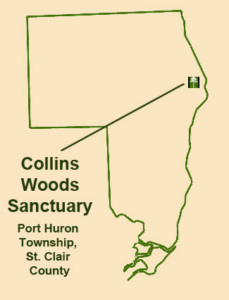
Collins Woods Sanctuary
32-Acre Swamp Forest Complex
Port Huron Township, Saint Clair County

32-Acre Swamp Forest Complex
Port Huron Township, Saint Clair County
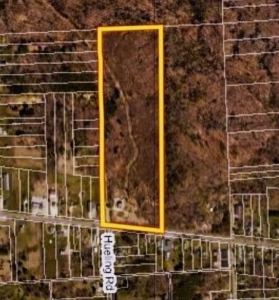
With another Wetland Conservation Program grant from Ducks Unlimited, along with a private donation, on 2026 May 8, the TLC purchased the 32-acre Collins Woods Sanctuary located at the northeast corner of Lapeer Road and Hueling Road in Port Huron Township. The preserve is part of one of the largest forest tracts remaining along the west side of Port Huron. Minus some residential development, about 500 acres of forest remain relatively non-fragmented and intact in this vicinity. Swamp forest is extensive in this large forest tract, which explains why it has remained mostly undeveloped. This forest provides major surface and ground water detention in the Stocks Creek watershed, making it very important for alleviating downstream flooding and for maintaining water quality of Stocks Creek and the lower Black River. Stocks Creek enters the Black River near the I-94/I-69 crossing west of Port Huron, which flows to the Saint Clair River in Port Huron.
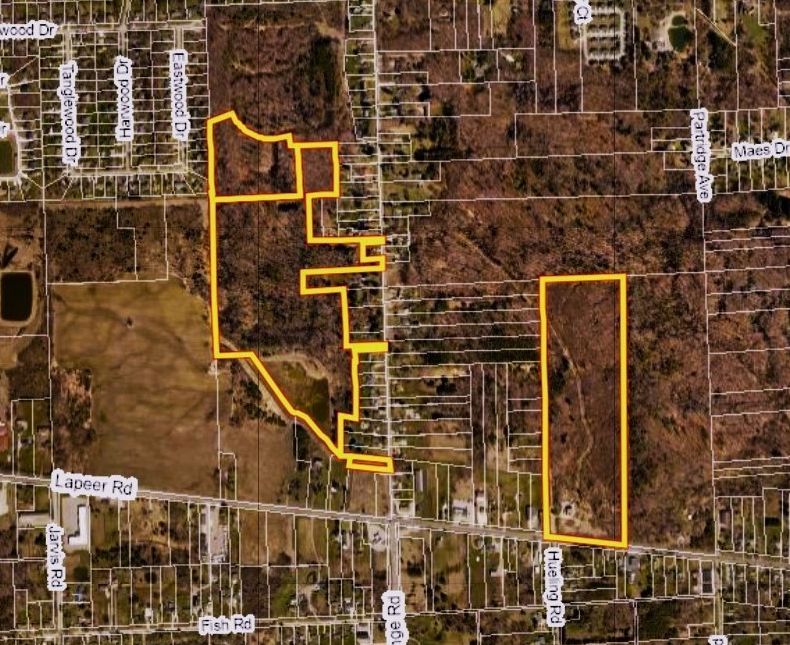
Outlined in yellow to the right: The 32-acre Collins Woods Sanctuary. To the left: 52 acres preserved in Kimball Township.
The Collins Woods Sanctuary is only about one-third mile east of two preserves in Kimball Township consisting of the 9.5-acre Sharon Rose Leonatti Memorial Plant Preserve owned by the Michigan Nature Association, and the 42.4-acre Marzolf Preserve owned by the Saint Clair County Drain Commissioner. Together, these two preserves protect nearly 52 acres of northern forest complex along with a large flood detention basin that has developed into a natural wetland complex.
About two-thirds, or about 20 acres, of the sanctuary consists of swamp forest wetland. The preserve is crossed by nearly 1,000 feet of the Stocks Creek and about 1,800 feet of the Baldwin Drain, a major tributary of Stocks Creek, making the preserve important to maintaining water quality in these watercourses.
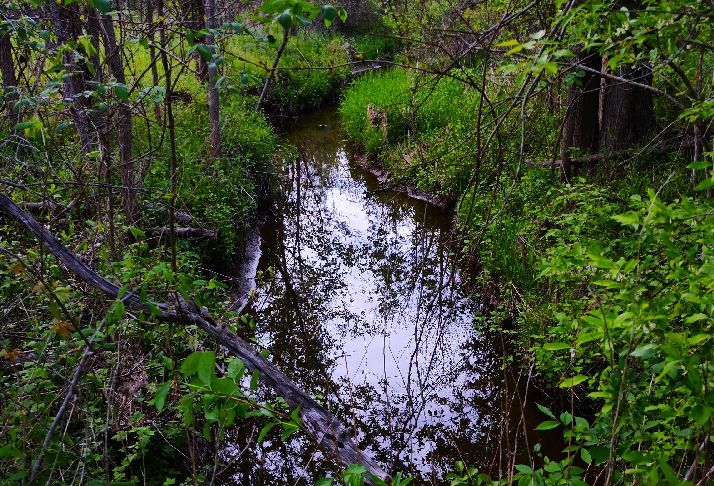
Stocks Creek on the Collins Woods Sanctuary. Photograph by Bill Collins.
The sanctuary consists largely of a northern forest complex unique to Port Huron, Kimball, and Clyde townships and the vicinity. This complex generally consists of extensive swamp forest interspersed with sandy upland forest dominated by northern plant species near the south edge of their range in eastern Michigan. But likewise, many southern plant species occur in this type of forest at the north edge of their range. As the Port Huron area is a mixing zone of northern and southern flora, due largely to the climate moderating effect of nearby Lake Huron, it is often difficult to determine whether some plant communities are northern or southern. What is very clear, however, is that because of the mix of northern and southern plant species, these forests are some of the most diverse in the Thumb.
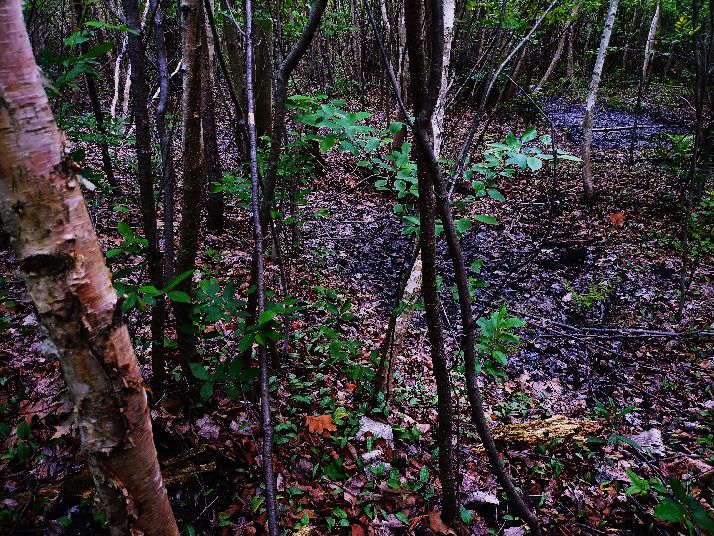
Typical swamp forest on the Collins Woods Sanctuary. Photograph by Bill Collins.
The sanctuary leans toward the northern side of the forest community spectrum. Although logged about 20 years ago, it appears that most of the native plant species have remained, the canopy consisting largely of Quaking Aspen, Bigtooth Aspen, Red Maple, and Paper Birch. To a lesser extent are Eastern White Pine, Red Oak, and even Black Gum. Understory species include Paper Birch, Speckled Alder, and Witch-hazel. The ground or herbaceous layer includes Interrupted Fern, Cinnamon Fern, Ostrich Fern, Sensitive Fern, Royal Fern, Northern Lady Fern, Bracken Fern, sedge Carex bromoides, other sedges, Canada Mayflower, Jack-in-the-pulpit, Wild Sarsaparilla, and Wintergreen. Extensive colonies of Bloodroot occur on the south end of the preserve, in open areas along Stocks Creek.
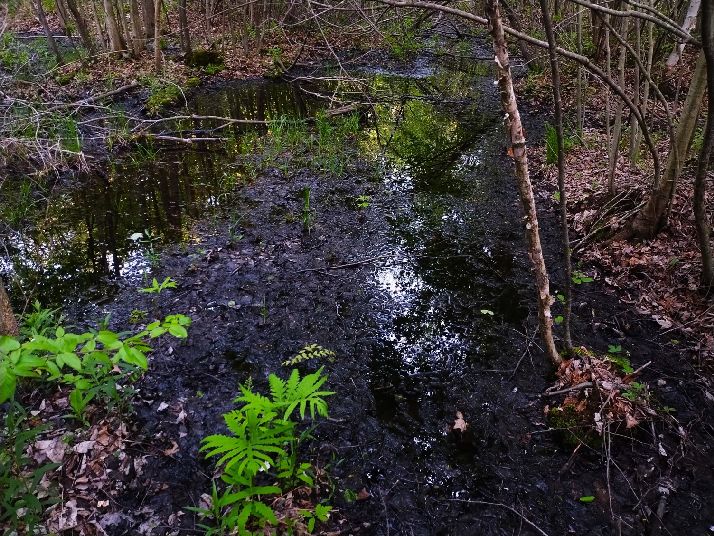
Inundated wetland on the Collins Woods Sanctuary. Photograph by Bill Collins.
There are few invasive weeds on the sanctuary. The primary weed is invasive Reed – Phragmites australis subspecies australis, which is mostly limited to the south end of the preserve near Stocks Creek where the land was historically cleared before logging and has remained relatively open. Much of the invasive Reed should gradually decline and die-off as the forest canopy reestablishes.
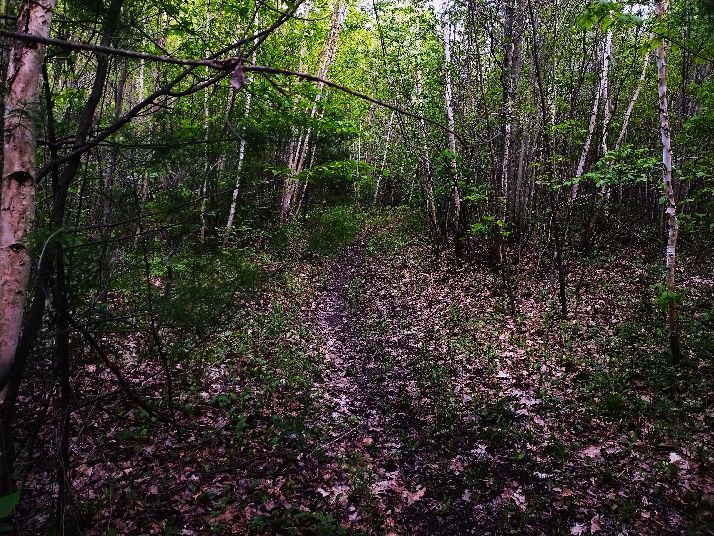
Trail on the Collins Woods Sanctuary. Photograph by Bill Collins.
A former logging trail extends around the sanctuary and should serve as a nice public walking trail as we are able to improve some portions. Walking along this sand trail feels very much like similar trails up-north with so much Paper Birch, Bracken Fern, and other generally northern vegetation. Being a relatively large forest area, surrounded on the north and east by more forest, the sanctuary is a haven for migratory birds requiring interior forest habitat, and of significant interest to the birding community.
The Collins Woods Sanctuary is named in honor of Robert Collins and his sister, Beverly (Collins) Strieter, who often explored this forest and Stocks Creek as youngsters in the 1940s and 1950s.